Carpenter Ants in South Florida: Hidden Nests and Warning Signs Homeowners Should Watch For
How Do I Know If I Have Carpenter Ants?
You may have carpenter ants if you repeatedly see large black or reddish-and-black ants inside your home, especially at night, or notice activity around damp wood, plumbing areas, windows, doors, attics, and rooflines. Other possible warning signs include loose ant trails, coarse wood debris near small openings, and winged ants appearing indoors.
Carpenter ants do not eat wood like termites. Instead, they use existing cavities or excavate wood softened by moisture or decay to create protected nesting spaces. In South Florida homes, nests may develop near leaking windows, damaged roof areas, plumbing leaks, damp wall voids, attic insulation, door frames, and other places where moisture has affected the structure.
Outdoor carpenter ant nests may be found in hollow trees, dead branches, rotting stumps, logs, old wooden fences, landscape timbers, mulch, and yard debris. Workers may travel from these outdoor nests toward the home by following tree branches, utility lines, fences, and other protected routes.
Seeing one carpenter ant indoors does not necessarily confirm that a nest is inside the house. However, repeated nighttime sightings, ants emerging from the same opening, indoor winged ants, or activity near moisture-damaged wood may indicate a nearby nesting site that should be evaluated.
In this guide, we’ll explain where carpenter ants nest, how moisture contributes to their activity, which warning signs homeowners should watch for, and how professional carpenter ant control can help address the source of the problem.
Where Do Carpenter Ants Nest in South Florida?
Carpenter ants commonly nest in protected spaces near moisture, food, and softened or previously damaged wood. Around South Florida homes, nests may be located outdoors in trees and landscaping or indoors within wall voids, attics, window frames, and other areas affected by moisture.
These ants do not eat wood. They may hollow out wood softened by moisture, decay, or fungi to create nesting galleries, but they can also occupy existing cavities that require little excavation.
Common Outdoor Carpenter Ant Nesting Areas
- Hollow trees and dead branches: Cavities, damaged limbs, and areas beneath loose bark can provide protected nesting spaces close to food and moisture.
- Tree stumps and fallen logs: Decaying wood offers the softened material carpenter ants may use to establish or expand a nest.
- Palm trees and dense landscaping: Carpenter ants may nest beneath old palm fronds, around tree roots, under mulch, or within debris protected by vegetation.
- Wooden structures and yard materials: Old fences, decks, landscape timbers, wood borders, sheds, stacked firewood, and damaged tree supports may attract nesting activity.
Common Indoor Carpenter Ant Nesting Areas
- Wall voids affected by moisture: Plumbing leaks, roof leaks, or exterior water intrusion can create damp, protected spaces inside walls.
- Window and door frames: Rain, sprinklers, and damaged seals may allow moisture to soften the surrounding wood and create suitable nesting conditions.
- Attics, rooflines, and insulation: Carpenter ants may enter through soffits, fascia gaps, vents, utility lines, or tree branches touching the home before nesting near the eaves or beneath insulation.
- Kitchens, bathrooms, and appliance areas: Spaces beneath sinks, bathtubs, dishwashers, and other fixtures may provide moisture and hidden cavities.
The carpenter ants homeowners see may be traveling between an outdoor nest and an indoor food or water source. Trails along tree branches, fences, exterior walls, cables, and utility lines can help reveal how the ants are reaching the structure.
Because the visible ants may be far from the actual nest, effective carpenter ant control should include an evaluation of both the home and surrounding landscape. Locating moisture problems, damaged wood, nesting cavities, and travel routes is essential for addressing the source of the activity.
What Are the Signs of Carpenter Ants in a House?
Common signs of carpenter ants include repeated sightings of large ants indoors, nighttime foraging activity, coarse debris near small openings, winged ants inside the home, and trails leading toward damp or damaged wood. Because a nest may be hidden inside a wall, attic, tree, or another protected space, homeowners often notice the workers before locating the colony.
Eight Carpenter Ant Warning Signs to Watch For
- Large ants appearing indoors: Florida carpenter ants are larger than many common household ants. Workers may have reddish or rusty-colored heads and middle sections with dark abdomens, although coloration can vary.
- Ant activity at night: Carpenter ants commonly forage after sunset and around dawn. Regularly seeing large ants in kitchens, bathrooms, or other rooms at night may indicate nearby activity.
- Loose trails along walls or structural edges: Workers may travel along exterior walls, fences, rooflines, baseboards, pipes, utility cables, or branches touching the house.
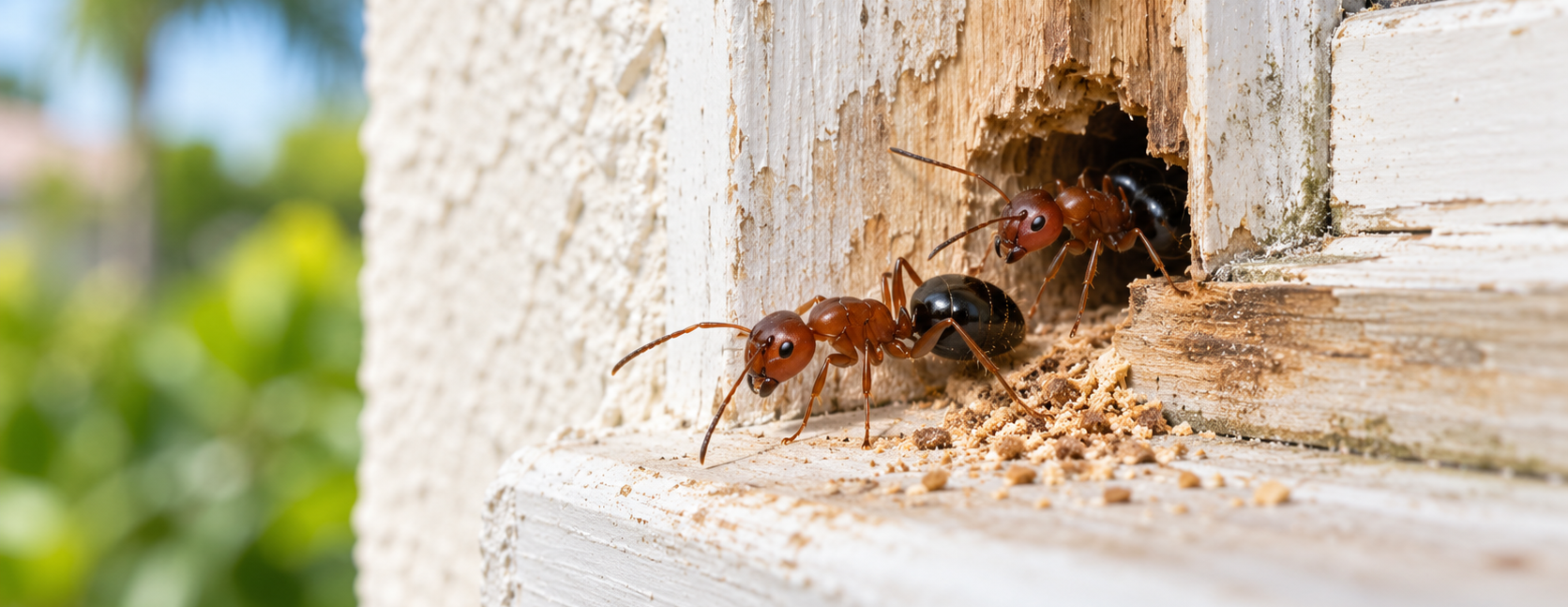
- Coarse debris near small openings: Carpenter ants may push excavated wood fragments, dead insects, and other nesting debris out of a cavity. This material, called frass, may collect beneath a small opening in wood, a wall, or a baseboard.
- Winged ants appearing indoors: Winged carpenter ants are reproductive members of a mature colony. Finding them inside, especially near windows, sliding doors, or lights, may indicate that a nest is located within or close to the structure.
- Activity around moisture-damaged wood: Repeated sightings near leaking windows, door frames, plumbing fixtures, roof damage, or damp walls can point toward conditions suitable for nesting.
- Ants emerging from cracks or hidden voids: Workers entering and leaving the same gap around a window, baseboard, electrical box, soffit, or wall may reveal a travel route connected to a concealed nest.
- Regular activity near kitchens and bathrooms: Carpenter ants may enter these rooms in search of sweets, water, or a protected nesting site, particularly when plumbing leaks or moisture problems are present.
One carpenter ant does not always mean a colony is nesting inside the home. It may be a worker traveling from an outdoor nest in a nearby tree, stump, or landscape feature. However, repeated sightings, indoor swarmers, frass, or activity concentrated around damp wood should not be ignored.
Homeowners should avoid relying on a single sign to identify the problem. Several ant species enter South Florida homes, and wood debris may also have other causes. Accurate identification and tracing the ants’ travel routes can help determine whether the activity comes from an indoor carpenter ant nest or an outdoor colony.
Why Are Carpenter Ants Attracted to Moisture-Damaged Wood?
Carpenter ants are attracted to moisture-damaged wood because it is softer and easier to excavate than dry, sound wood. Damp structural areas may also provide the humidity, shelter, and access to water that carpenter ants need when establishing a protected nesting site.
Carpenter ants do not consume wood for nutrition. They remove softened material to create smooth nesting galleries or take advantage of cavities that already exist. This is why carpenter ant activity may be associated with an underlying leak, drainage problem, damaged seal, or area of wood decay.
Moisture Problems That Can Support Carpenter Ant Activity
- Leaking windows and doors: Damaged caulking, worn seals, and repeated exposure to rain or sprinklers can allow moisture to collect around wooden frames.
- Roof and soffit leaks: Water entering near roof edges, fascia boards, vents, or damaged roofing may affect wood and insulation inside the attic.
- Plumbing leaks: Slow leaks beneath sinks, behind appliances, around bathroom fixtures, or inside walls can create damp nesting conditions that remain hidden.
- Air-conditioning drainage problems: Condensation and clogged or leaking drain lines may introduce moisture into walls, ceilings, or areas near the air-conditioning system.
- Poor exterior drainage: Water collecting near the foundation, deck, or attached wooden structures can contribute to long-term moisture problems.
- Overwatering and sprinkler exposure: Irrigation repeatedly striking the house may keep window frames, doors, siding, landscaping, and nearby wood damp.
South Florida’s frequent storms can make existing moisture problems more noticeable. Carpenter ants may also change their foraging routes as outdoor conditions shift, which is one reason homeowners sometimes notice increased ant activity after rain.
Finding carpenter ants does not automatically mean a home has extensive wood damage or a hidden leak. Workers may enter from an outdoor nest while searching for food or water. However, repeated activity around the same damp area should prompt homeowners to look for the condition attracting the ants.
Addressing the moisture source is an important part of long-term carpenter ant management. Treatment may reduce the colony, but unrepaired leaks, decaying wood, and persistent dampness can continue providing suitable conditions for future activity.
How Do Carpenter Ants Get Inside South Florida Homes?
Carpenter ants enter homes by following branches, utility lines, fences, and structural edges toward small openings around the roofline, windows, doors, vents, and exterior walls. They may come inside searching for food or moisture, or they may be traveling to a protected nesting site within the structure.
Because carpenter ants often forage at night, homeowners may not notice these entry routes during the day. Watching where the ants appear after sunset can help reveal whether they are traveling from an outdoor nest or emerging from a concealed area inside the home.
Common Carpenter Ant Entry Routes
- Tree branches touching the structure: Limbs, palm fronds, vines, and shrubs can act as bridges between outdoor nesting areas and the roof, walls, windows, or screen enclosure.
- Utility wires and cables: Carpenter ants may follow electrical lines, internet cables, plumbing pipes, and air-conditioning lines into attics or wall voids.
- Gaps around windows and doors: Damaged caulking, worn weatherstripping, and openings around moisture-affected frames can provide direct access to the interior.
- Roofline openings: Gaps around soffits, fascia boards, vents, eaves, and damaged roofing may allow ants to enter attic spaces.
- Cracks and construction gaps: Openings in stucco, siding, foundations, expansion joints, and areas where different building materials meet can serve as entry points.
- Attached outdoor structures: Fences, decks, pergolas, gutters, patios, and screen enclosures may provide protected routes leading directly toward the home.
What Can a Carpenter Ant Trail Reveal?
A carpenter ant trail may reveal the direction of a food source, moisture problem, entry point, or nesting area. Unlike ants that travel in tightly organized lines, Florida carpenter ants may forage in loose trails or appear to wander individually along walls, trees, or structural edges.
Homeowners may notice ants moving:
- From a tree or shrub toward the roofline
- Along a cable entering the exterior wall
- Beneath a window or door frame
- Between a bathroom or kitchen and a wall opening
- Along a baseboard before disappearing into a crack
- From an attic or soffit toward the exterior
The place where carpenter ants disappear can offer a useful clue, but it does not always identify the exact nest location. A trail may lead to an entry point while the actual colony remains outdoors, or it may connect an indoor nesting site with an exterior food source.
Avoid disturbing the trail before noting where the ants are coming from and where they are going. Photographing the route or marking the entry area can provide helpful information when the property is evaluated.
How Can You Identify Carpenter Ants?
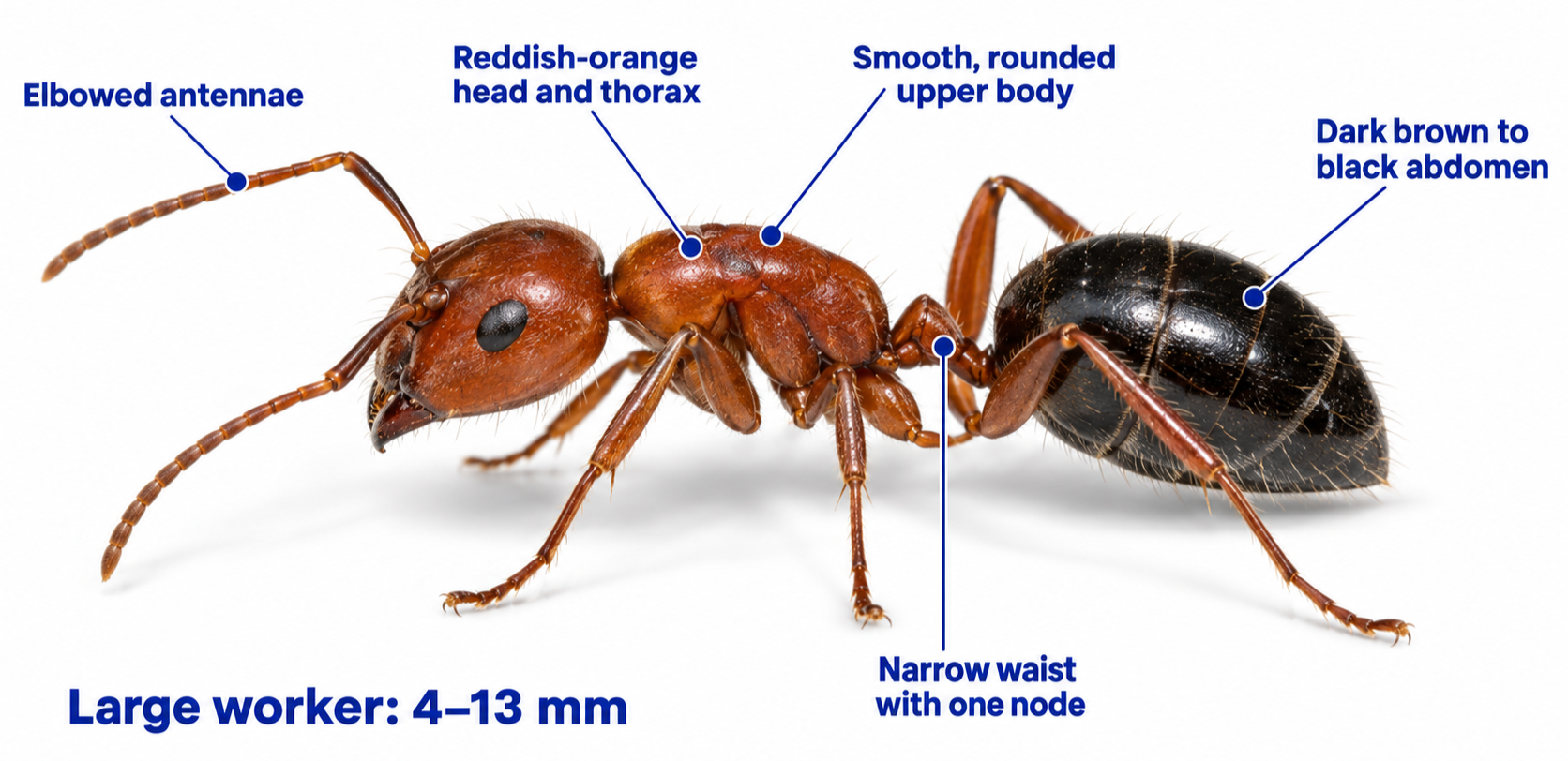
Carpenter ants can often be identified by their large size, reddish-orange and black coloring, elbowed antennae, narrow waists, and nighttime activity. However, worker size and coloring can vary, so behavior and nesting location should also be considered.
The Florida carpenter ant is one of the species most commonly found around South Florida structures. Its workers typically have reddish-orange heads and middle body sections with dark brown or black abdomens.
Common Carpenter Ant Identification Features
- Large worker ants: Carpenter ant workers may range from approximately 4 to 13 millimeters long. Different-sized workers can be present within the same colony.
- Reddish-orange and black coloring: Florida carpenter ants commonly have reddish or rusty-colored heads and middle sections that contrast with their dark abdomens.
- Elbowed antennae: Their antennae have a noticeable bend rather than extending straight from the head.
- Narrow waist: Carpenter ants have a pinched waist with one visible node between the middle section and abdomen.
- Smooth, rounded upper body: When viewed from the side, the upper surface of the middle body has an evenly rounded appearance.
- Nighttime foraging: Workers are commonly active after sunset and around dawn, sometimes traveling alone or along loosely defined trails.
Carpenter ants are noticeably larger than white-footed ants, which have smaller, mostly dark bodies with pale coloring near the ends of their legs. Observing the ants’ size, color, trail pattern, and preferred nesting areas can help narrow down the species.
Carpenter Ants vs. Termites
Carpenter ants and termites may both be associated with wood and can produce winged swarmers, but they are different insects with different nesting and feeding behaviors.
Carpenter ants have narrow waists, elbowed antennae, and front wings that are longer than their rear wings. Termite swarmers have broader waists, straighter antennae, and wings that are approximately equal in length.
The condition of the wood may also provide clues. Carpenter ants excavate or occupy cavities in softened wood and may leave coarse debris containing wood fragments and insect remains. Termites consume wood and may leave distinctly shaped pellets, mud tubes, or other evidence depending on the termite species.
Because winged ants and termite swarmers can be difficult to distinguish from a distance, homeowners should save a specimen or take a clear photograph rather than relying on color or size alone. Proper identification is important before deciding how the activity should be addressed.
How Can Homeowners Help Prevent Carpenter Ants?
Homeowners can help prevent carpenter ants by correcting moisture problems, removing damaged wood, eliminating outdoor nesting materials, trimming vegetation away from the structure, and sealing potential entry points. Prevention is most effective when both the home and surrounding landscape are addressed.
Eight Ways to Reduce Carpenter Ant Activity
- Repair plumbing and roof leaks: Correct leaks beneath sinks, behind appliances, around bathroom fixtures, inside walls, and near the roof before moisture affects surrounding materials.
- Replace moisture-damaged wood: Repair or replace softened window frames, fascia boards, door frames, decking, siding, and other deteriorating wooden materials.
- Trim trees and shrubs away from the home: Cut back branches, palm fronds, vines, and dense vegetation touching the roof, walls, windows, or screen enclosure.
- Remove outdoor nesting materials: Clear away rotting stumps, fallen branches, decaying logs, unused landscape timbers, and other damaged wood near the structure.
- Store firewood properly: Keep firewood raised off the ground and away from exterior walls. Inspect individual pieces before bringing them indoors.
- Seal structural openings: Close gaps around windows, doors, soffits, fascia boards, vents, pipes, cables, and utility penetrations with materials appropriate for each location.
- Improve drainage and irrigation: Redirect water away from the foundation, repair leaking irrigation lines, and adjust sprinklers that repeatedly soak wooden frames or exterior walls.
- Reduce food sources and monitor activity: Clean sugary spills, store food securely, manage overflowing trash, and watch for nighttime trails around kitchens, bathrooms, trees, and exterior walls.
Preventive changes can reduce suitable nesting conditions and block common travel routes, but they may not eliminate an established colony. Sealing every visible gap without determining where the ants are nesting may simply cause workers to use another opening.
If carpenter ants continue appearing after moisture, landscaping, and entry-point problems have been addressed, the property may require a professional evaluation to determine whether the nest is inside the structure or somewhere outdoors nearby.
How Does Professional Carpenter Ant Control Work?
Professional carpenter ant control begins with correctly identifying the ant species, tracing active travel routes, and determining whether the colony is nesting inside the home or outdoors nearby. Because the ants visible in a kitchen or bathroom may be far from the nest, treating only the workers homeowners see may provide temporary relief without addressing the source.
A complete evaluation should consider the structure and surrounding landscape. Trees, stumps, fences, mulch, rooflines, attics, wall voids, plumbing areas, and moisture-damaged wood may all contribute to carpenter ant activity.
What Carpenter Ant Control May Include
- Accurate species identification: The ants are examined to distinguish carpenter ants from white-footed ants, fire ants, ghost ants, and other species requiring different control strategies.
- Indoor and outdoor evaluation: The technician checks active rooms, exterior walls, landscaping, trees, roof edges, moisture-prone areas, and other potential nesting locations.
- Tracing trails and entry routes: Nighttime activity, utility lines, branches, structural edges, and openings may help reveal how workers are traveling between the nest and the home.
- Locating moisture and damaged wood: Areas affected by plumbing leaks, roof problems, rain intrusion, irrigation, or decay are evaluated because these conditions may support nesting activity.
- Targeted treatment: The treatment method and application areas are selected based on the ant species, nest location, severity of activity, and conditions around the property.
- Prevention and monitoring recommendations: Homeowners may be advised to correct moisture problems, trim vegetation, remove damaged wood, seal entry points, and monitor areas where activity was previously observed.
Effective carpenter ant control focuses on more than eliminating ants moving across a visible surface. The goal is to identify the nesting area, address the routes allowing ants into the home, and reduce the conditions supporting continued activity.
Before an upcoming service, homeowners can review Professional Pestguard’s ant-control preparation guide for steps that can improve access to treatment areas and help the visit proceed smoothly.
Frequently Asked Questions About Carpenter Ants
Carpenter ants can be difficult to locate because they may nest outdoors while sending workers into the home for food or moisture. Below are answers to common questions South Florida homeowners ask about carpenter ant identification, nesting areas, wood, and warning signs.
How do I know if I have carpenter ants?
Possible signs include repeated sightings of large black or reddish-and-black ants, nighttime activity, loose trails, coarse debris near small openings, winged ants indoors, and activity concentrated around moisture-damaged wood. Proper identification is important because several ant species may enter South Florida homes.
Where do carpenter ants usually build nests?
Outdoors, carpenter ants may nest in hollow trees, dead branches, stumps, logs, mulch, old fences, landscape timbers, and damaged wooden structures. Indoor nests may be located in damp wall voids, attics, roof areas, window frames, door frames, insulation, and spaces near plumbing fixtures.
Do carpenter ants eat wood?
No. Carpenter ants do not eat wood like termites. They may remove softened or decaying wood to create nesting galleries, then push the excavated material and other debris out of the nest.
Can carpenter ants damage a house?
Carpenter ants may enlarge cavities in moisture-damaged or decaying wood while establishing a nest. Florida carpenter ants generally do not excavate sound wood, but recurring activity may reveal an underlying leak, damaged material, or protected structural void that needs attention.
What does carpenter ant frass look like?
Carpenter ant frass is coarse debris that may contain shredded wood fragments, dead ants, discarded insect parts, and other material removed from the nest. It may collect beneath a small opening in a wall, baseboard, window frame, or wooden surface.
Why do I mostly see carpenter ants at night?
Florida carpenter ants commonly forage after sunset and around dawn. At night, workers may leave their nest to search for sweets, moisture, honeydew, and other insects, making indoor or exterior activity easier to notice.
Do winged carpenter ants mean there is a nest inside?
Winged carpenter ants appearing indoors may indicate that a mature nest is located inside or close to the structure, but their presence alone does not confirm the exact location. Because carpenter ant swarmers can be confused with termites, the insects should be properly identified.
When should I call a pest control company for carpenter ants?
Consider professional carpenter ant control when ants repeatedly appear indoors, workers emerge from the same opening, winged ants are found inside, frass accumulates, or activity is concentrated around damp or damaged wood. Locating the nest and correcting contributing moisture conditions are important for long-term management.
Key Takeaways
Carpenter ants may nest inside a home or travel indoors from an outdoor colony nearby. Repeated activity, especially near moisture-damaged wood, should be evaluated carefully to identify the species, locate possible nesting areas, and determine how the ants are entering.
Here’s What Homeowners Should Remember
- Carpenter ants are typically larger than common household ants and may have reddish-orange and black coloring.
- Outdoor nests may be found in hollow trees, dead branches, stumps, logs, mulch, fences, and damaged wooden structures.
- Indoor nests may develop in damp wall voids, attics, roof areas, window frames, door frames, and spaces near plumbing leaks.
- Carpenter ants do not eat wood, but they may excavate wood that has already been softened by moisture, decay, or fungi.
- Nighttime sightings, loose trails, frass, indoor winged ants, and activity around damp wood are important warning signs.
- Effective carpenter ant control includes proper identification, nest location, targeted treatment, moisture correction, exclusion, and follow-up monitoring.
Conclusion
Carpenter ants in a South Florida home may be searching for food or moisture, traveling from an outdoor colony, or nesting within a protected structural space. Large ants appearing repeatedly at night, loose trails, frass, indoor swarmers, and activity around damp or damaged wood are important signs homeowners should watch for.
Because carpenter ant nests can be located inside walls, attics, window frames, trees, stumps, or landscaping, eliminating only the workers you see may not resolve the problem. Effective management begins with identifying the ant species, tracing its travel routes, locating possible nesting areas, and correcting the moisture or access conditions supporting the activity.
Need Carpenter Ant Control in South Florida?
Professional Pestguard provides professional carpenter ant control services for homeowners in Weston, Broward County, and surrounding South Florida communities. With more than 40 years of experience, our licensed team understands the nesting habits, moisture conditions, and entry routes associated with carpenter ants in local homes.
If you are finding carpenter ants inside your house or noticing signs of a nearby nest, call (954) 389-6107 or fill out our free estimate request form to request your free estimate.
About Professional Pestguard
Professional Pestguard provides professional pest control in Weston, FL and nearby communities including Davie, Sunrise, Pembroke Pines, and Plantation. With over 40 years of experience, our licensed technicians protect homes and businesses across Broward County and Miami-Dade County from ants, cockroaches, rodents, spiders, and other common South Florida pests using safe and effective treatments.