White-Footed Ant Control for HOAs: Why Colonies Keep Spreading Between Buildings
Why Do Ants Keep Spreading Between Buildings in an HOA or Multifamily Community?
White-footed ants keep spreading between buildings because numerous interconnected nests can develop throughout the landscaping and structures of an HOA or multifamily community. Workers follow established trails across trees, shrubs, fences, rooflines, gutters, exterior walls, and utility routes, allowing activity to move between outdoor areas and multiple buildings. Treating only one unit or visible trail may leave other active nesting areas across the property.
For property managers, effective control requires a coordinated approach that addresses exterior food sources, landscape bridges, nesting sites, structural entry points, and activity throughout the community. This guide explains why white-footed ants spread, where they commonly nest, which conditions support them, and how professional commercial pest control can help manage activity across the property.
Why Do White-Footed Ants Spread So Easily Across HOA Properties?
White-footed ants spread easily across HOA and multifamily properties because their colonies can include numerous interconnected nests supported by landscaping, dependable food sources, and shared structural pathways. Once established, workers may travel continuously between outdoor nesting areas and multiple buildings.
Six Reasons White-Footed Ant Activity Spreads
- Large colony populations: White-footed ant colonies can contain thousands or even millions of individuals, allowing large numbers of workers to forage throughout an entire community.
- Interconnected nesting sites: Nests may be distributed among trees, shrubs, mulch, leaf litter, gutters, attics, and wall voids. These nesting areas can function as parts of a much larger colony rather than separate infestations.
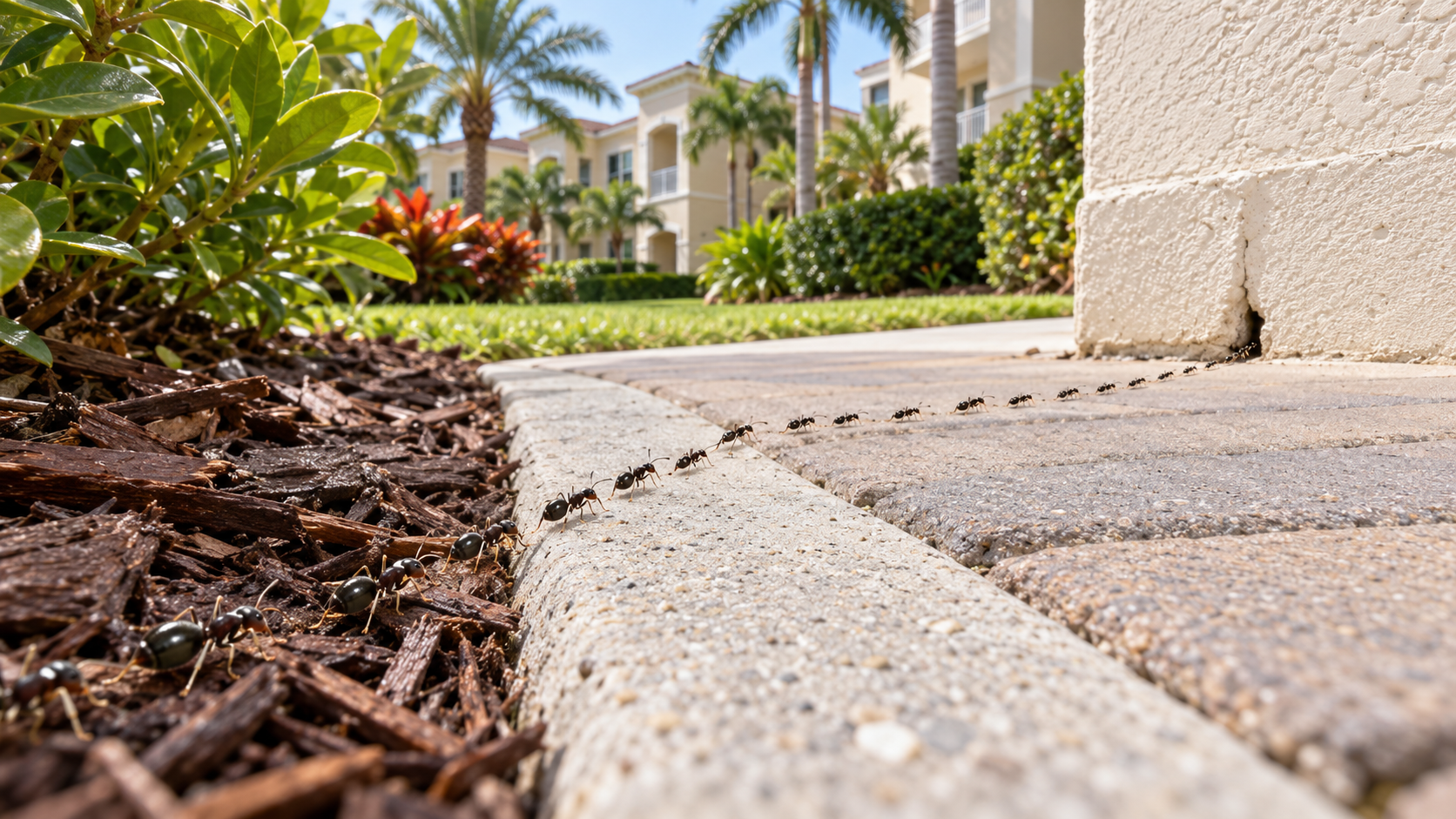
- Persistent pheromone trails: Workers leave chemical trails that guide other ants toward food, moisture, and shelter. Successful routes may remain active for months.
- Reliable landscape food sources: Aphids, scales, mealybugs, and other plant-feeding insects produce sugary honeydew that attracts white-footed ants to palms, trees, shrubs, and flowering plants.
- Vegetation touching buildings: Tree branches, palm fronds, vines, and shrubs can create bridges between landscape nests and roofs, soffits, balconies, windows, and exterior walls.
- Connected structural pathways: Fences, gutters, rooflines, utility cables, plumbing penetrations, and wall voids can help ants travel from one section of a multifamily property to another.
Because activity can extend across several buildings and landscape zones, a complaint from one resident may represent only one visible part of a larger property-wide problem. Property managers should document where trails are appearing and whether nearby buildings share vegetation, fencing, utilities, or other travel routes.
Correct identification is also important before developing a control plan. Our guide to white-footed ants in South Florida explains their appearance, trail behavior, nesting habits, and common entry points.
Where Do White-Footed Ants Nest in HOA and Multifamily Communities?
White-footed ants commonly nest at or above ground level in landscaping, trees, organic debris, gutters, attics, and wall voids. Nests are found outdoors more often than indoors, but workers may travel between exterior nests and several buildings through vegetation, rooflines, utility routes, and structural openings.
A large community may contain numerous connected nesting sites rather than one central nest. This makes it important for property managers to evaluate the entire landscape and building perimeter instead of focusing only on the unit where ants were reported.
Common Landscape Nesting Areas
- Palms and mature trees: Nests may be hidden inside tree holes, beneath loose bark, under old palm fronds, or within accumulated organic material around leaf bases.
- Shrubs and ornamental plants: Dense foliage provides shade, moisture, protection, and access to nectar or honeydew-producing insects.
- Mulch, leaf litter, and ground debris: Loose organic material can provide protected nesting spaces around foundations, landscape beds, drainage areas, and tree bases.
- Fences and landscape connections: Vegetation growing along fences, walls, and shared property boundaries can support nests while creating continuous travel routes between buildings.
Common Structural Nesting Areas
- Rain gutters and roof debris: Leaves and organic material trapped in gutters can provide protected, moisture-rich nesting conditions near the roofline.
- Soffits and attics: Ants traveling from overhanging trees may enter through soffit vents or roof gaps and establish activity in protected attic areas.
- Wall voids: Small openings around utilities, exterior panels, windows, and doors may allow ants to enter concealed spaces inside building walls.
- Shared utility pathways: Electrical cables, plumbing penetrations, conduits, and connected structural voids can help ants move through or between buildings.
The room, unit, or building where ants become visible may not contain the primary nest. Workers seen in a kitchen, bathroom, office, or clubhouse may be traveling from landscaping or another part of the property to reach food or moisture indoors.
Mapping nesting conditions across the landscape and structures helps property managers understand whether a complaint is isolated or part of a broader white-footed ant problem.
How Does HOA Landscaping Help White-Footed Ants Spread?
HOA landscaping helps white-footed ants spread by providing food, moisture, nesting material, and direct pathways to nearby buildings. Palms, flowering shrubs, mature trees, mulch beds, and dense vegetation can support large ant populations while branches and vines touching structures create bridges to roofs, walls, balconies, and windows.
Six Landscape Conditions That Support White-Footed Ant Activity
- Honeydew-producing insects: Aphids, scales, mealybugs, and other plant-feeding insects produce sugary honeydew that white-footed ants collect from leaves, stems, and tree trunks.
- Flowering and nectar-producing plants: Gardenias, hibiscus, ixora, fruit trees, and other ornamental plants may provide dependable food sources that keep workers active in the landscape.
- Palms and mature trees: Tree holes, loose bark, old palm fronds, leaf bases, and dense canopies offer protected nesting sites above ground.
- Branches touching buildings: Tree limbs, palm fronds, vines, and shrubs that contact roofs, soffits, balconies, or exterior walls allow ants to bypass ground-level barriers.
- Mulch and accumulated debris: Loose mulch, leaf litter, fallen branches, and organic material in landscape beds or gutters can provide moisture and shelter for additional nests.
- Frequent irrigation: Overwatering, leaking irrigation components, and sprinklers repeatedly striking buildings can create dependable moisture around foundations, walls, and planting areas.
Why Landscape and Pest-Control Teams Must Coordinate
White-footed ant control is more effective when property managers, landscaping crews, maintenance teams, and pest-control technicians share information. A landscaping crew may notice trails on trees or recurring activity around certain plants before residents begin reporting ants inside nearby buildings.
Property managers can support coordinated control by asking landscaping teams to:
- Report heavy ant trails on trees, palms, fences, and building walls
- Identify plants affected by aphids, scales, or mealybugs
- Trim vegetation touching roofs, balconies, windows, and exterior walls
- Remove unnecessary leaf litter, dead branches, and landscape debris
- Correct irrigation leaks and sprinkler overspray
- Avoid disturbing known trails before the pest-control provider evaluates them
Managing the landscape does not eliminate an established colony by itself. However, reducing food sources, nesting material, moisture, and structural bridges can make professional treatment more effective and help limit reinfestation between scheduled services.
Why Is Treating One Building Not Enough for White-Footed Ant Control?
Treating one building is often not enough because white-footed ants may occupy interconnected nests across landscaping, shared structures, and neighboring buildings. Even if activity decreases in one location, untreated portions of the colony can continue foraging and maintain trails throughout the community.
Why Isolated Ant Treatments Often Provide Temporary Results
- The visible ants may come from another area: Workers found inside one unit may be traveling from a tree, shrub, gutter, attic, or neighboring building.
- Multiple nests may support the colony: Addressing one nesting site does not necessarily affect other nests distributed throughout the property.
- Shared pathways remain active: Rooflines, fences, utility lines, plumbing penetrations, and touching vegetation can continue carrying ants between buildings.
- Outdoor food sources remain available: Honeydew-producing insects and flowering plants may continue supporting large ant populations in untreated landscape zones.
- Trails may shift to new routes: When one pathway is interrupted, workers may begin using another structural opening or landscape connection.
- Resident-by-resident treatments are difficult to coordinate: Treating individual complaints at different times can leave nearby nesting areas and travel routes unaddressed.
A more complete strategy begins by mapping activity across the community, identifying common nesting conditions, and coordinating service for affected buildings and landscape zones. Resident reports can help reveal patterns, but they should be evaluated as part of the broader property rather than treated as unrelated indoor infestations.
Professional commercial ant control can help property managers develop a coordinated plan that addresses active trails, potential nesting areas, landscape conditions, and structural entry points throughout the community.
What Are the Signs of a Property-Wide White-Footed Ant Problem?
A property-wide white-footed ant problem may be present when long trails appear across landscaping, exterior walls, rooflines, shared walkways, and multiple buildings. Repeated reports from different residents can indicate that the ants are moving through a connected network of outdoor and structural nesting areas.
Six Signs Property Managers Should Watch For
- Long trails on trees and buildings: Large numbers of small, dark ants may travel along tree trunks, fences, sidewalks, exterior walls, gutters, and roof edges.
- Reports from multiple units: Complaints occurring in several apartments, condos, or buildings may indicate a broader colony rather than unrelated indoor problems.
- Ants returning after individual treatments: Activity that repeatedly disappears and returns may mean other nests and travel routes remain active elsewhere on the property.
- Heavy activity around landscaping: Trails on palms, shrubs, flowering plants, and mulch beds may be connected to outdoor nests or honeydew-producing insects.
- Movement along shared structures: Ants may follow utility cables, plumbing lines, fences, balconies, covered walkways, and connected rooflines between buildings.
- Indoor activity near moisture or openings: Residents may report ants around sinks, bathrooms, windows, doors, electrical outlets, or other areas that provide water or access to wall voids.
What Should Property Managers Document?
Property managers should record the building or unit number, exact location, date, time, trail direction, and nearby landscaping or structural features for each report. Photographs can also help identify whether separate complaints follow the same travel route.
Tracking these details over time can reveal clusters of activity and help determine which buildings, landscape zones, and shared pathways should be evaluated together.
How Should an HOA Coordinate White-Footed Ant Control?
An HOA should coordinate white-footed ant control by evaluating the entire property, mapping resident reports, inspecting connected landscape and structural areas, and scheduling treatment and follow-up as one community-wide effort. This approach helps address the nesting network and travel routes that allow ants to spread between buildings.
Six Steps for a Coordinated HOA Ant-Control Plan
- Create one reporting process: Ask residents and maintenance teams to report the building number, unit, exact location, date, and direction of visible ant trails.
- Map activity across the property: Plot reports from units, common areas, landscaping, rooflines, utility zones, and exterior walls to identify connected patterns.
- Inspect beyond the reported unit: Evaluate nearby buildings, trees, shrubs, mulch beds, gutters, soffits, wall openings, and shared utilities that may support the same colony.
- Coordinate landscape maintenance: Schedule pruning, debris removal, irrigation repairs, and management of honeydew-producing plant pests alongside the ant-control plan.
- Treat connected areas together: When possible, coordinate service for affected buildings and surrounding landscape zones instead of responding to each complaint separately.
- Continue monitoring after treatment: Track whether trails decrease, return, or move to new areas so the plan can be adjusted as additional nesting sites become apparent.
Clear communication is also important. Residents should know where to report activity and avoid disturbing trails before they can be evaluated. Maintenance and landscaping teams should share their observations with the property manager so new activity does not go undocumented.
Professional Pestguard provides commercial pest control services for HOAs, multifamily communities, and property managers throughout South Florida. A coordinated plan can help address white-footed ant activity across the landscape and structures instead of treating each resident complaint as an isolated problem.
How Does Professional White-Footed Ant Control Work for HOA Communities?
Professional white-footed ant control begins with confirming the species, tracing active trails, and evaluating nesting conditions across buildings and landscaping. Because the ants may occupy numerous connected nesting sites, the control plan should address the broader property rather than only the areas where workers are visible.
What a Commercial Ant-Control Plan May Include
- Species identification: A technician confirms that the ants are white-footed ants and not another small species with different nesting or feeding habits.
- Property-wide evaluation: Active trails, reported units, common areas, landscaping, rooflines, utility routes, moisture sources, and potential nesting spaces are assessed.
- Activity mapping: Visible trails and resident reports are compared to identify connections between buildings, vegetation, and structural pathways.
- Targeted treatment: Treatment methods are selected according to the species, nesting locations, property layout, and level of activity. Products are applied according to their labels.
- Corrective recommendations: Property managers may receive guidance about pruning vegetation, removing organic debris, repairing leaks, cleaning gutters, or sealing structural openings.
- Follow-up monitoring: Additional evaluations help determine whether activity has decreased, shifted to another route, or revealed nesting areas that were previously hidden.
The goal is to reduce the colony populations sustaining the activity while limiting the conditions that allow ants to travel between landscaping and buildings. Because white-footed ant colonies can be widespread, improvement may require continued monitoring and adjustments rather than a single isolated application.
A customized commercial ant-control plan gives property managers a structured way to address active infestations, recurring resident complaints, and the property conditions contributing to the problem.
Frequently Asked Questions About White-Footed Ants in HOA Communities
Property managers often have questions about why white-footed ants spread, where they nest, and how recurring complaints should be handled across a multifamily property. Below are concise answers to common questions about HOA ant control.
Why do ants keep spreading between buildings in an HOA community?
White-footed ants may spread between buildings because large colonies can occupy multiple connected nests throughout landscaping and structures. Vegetation, fences, rooflines, utility cables, and wall openings provide routes between nesting areas and buildings.
Does seeing ants in one unit mean the nest is inside that unit?
Not necessarily. Workers found in a kitchen or bathroom may be traveling from an outdoor nest in a tree, shrub, gutter, or mulch bed. The trail should be evaluated to determine where the ants are entering and where they may be nesting.
Where do white-footed ants nest on multifamily properties?
White-footed ants commonly nest in palms, trees, shrubs, mulch, leaf litter, gutters, attics, soffits, and wall voids. A community may contain numerous connected nesting sites rather than one central nest.
Why do white-footed ants return after one building is treated?
Activity may return when untreated nests, outdoor food sources, or shared travel routes remain active nearby. Workers from other parts of the colony may continue entering through the same opening or establish a different trail.
Can HOA landscaping contribute to white-footed ant activity?
Yes. Dense vegetation, touching branches, damp mulch, organic debris, frequent irrigation, and honeydew-producing insects can provide food, moisture, shelter, and direct pathways to buildings.
Should residents spray visible white-footed ant trails?
Residents should report the trail before disturbing it whenever possible. Spraying visible workers may reduce activity temporarily, but it can make the route harder to trace without addressing the colony supporting it.
What information should property managers collect from residents?
Ask for the building and unit number, exact location, date and time observed, direction of the trail, and a photograph if available. Consistent reports make it easier to identify activity patterns across the property.
Can one treatment permanently prevent white-footed ants from returning?
No treatment can guarantee that white-footed ants will never return. Large outdoor populations, neighboring properties, landscaping conditions, and hidden nesting sites may contribute to future activity. Ongoing monitoring provides stronger long-term management than relying on one application.
Key Takeaways
White-footed ants can spread throughout HOA landscapes and multifamily communities by using interconnected nests, dependable food sources, and shared travel routes. Successful control requires property-wide coordination rather than treating each resident complaint as an isolated problem.
What Property Managers Should Remember
- White-footed ants may establish numerous connected nests across landscaping, gutters, attics, soffits, and wall voids.
- Trees, shrubs, fences, rooflines, utility cables, and plumbing penetrations can help ants travel between buildings.
- Honeydew-producing insects, flowering plants, moisture, mulch, and organic debris can support large outdoor populations.
- Ants found inside a unit may be traveling from landscaping or another section of the property.
- Treating one room or building may leave neighboring nests and active travel routes unaddressed.
- Effective HOA ant control combines reporting, activity mapping, landscape coordination, targeted treatment, and follow-up monitoring.
Conclusion
White-footed ants keep spreading between buildings in HOA and multifamily communities because their colonies may include numerous connected nests throughout landscaping and structures. Trees, shrubs, rooflines, fences, utilities, and small building openings allow workers to travel across the property while outdoor food and moisture sources support continued activity.
Effective white-footed ant control requires more than responding to individual resident complaints. Property-wide reporting, coordinated landscape maintenance, targeted treatments, and follow-up monitoring can help address the colony network and the conditions allowing ants to move between buildings.
Need White-Footed Ant Control for Your HOA or Multifamily Community?
Professional Pestguard provides commercial pest control services for HOAs, multifamily communities, property managers, and commercial properties throughout Broward County and South Florida. With more than 40 years of experience, our licensed team can evaluate the activity and recommend a customized ant-control plan based on your property’s layout and needs.
Call (954) 389-6107 or fill out our free estimate request form to request a free estimate.
About Professional Pestguard
Professional Pestguard provides professional pest control in Weston, FL and nearby communities including Davie, Sunrise, Pembroke Pines, and Plantation. With over 40 years of experience, our licensed technicians protect homes and businesses across Broward County and Miami-Dade County from ants, cockroaches, rodents, spiders, and other common South Florida pests using safe and effective treatments.